
Solar Screens (Sun Screens) Prevent Turf Burn: How to Protect New Artificial Turf From Window Glare
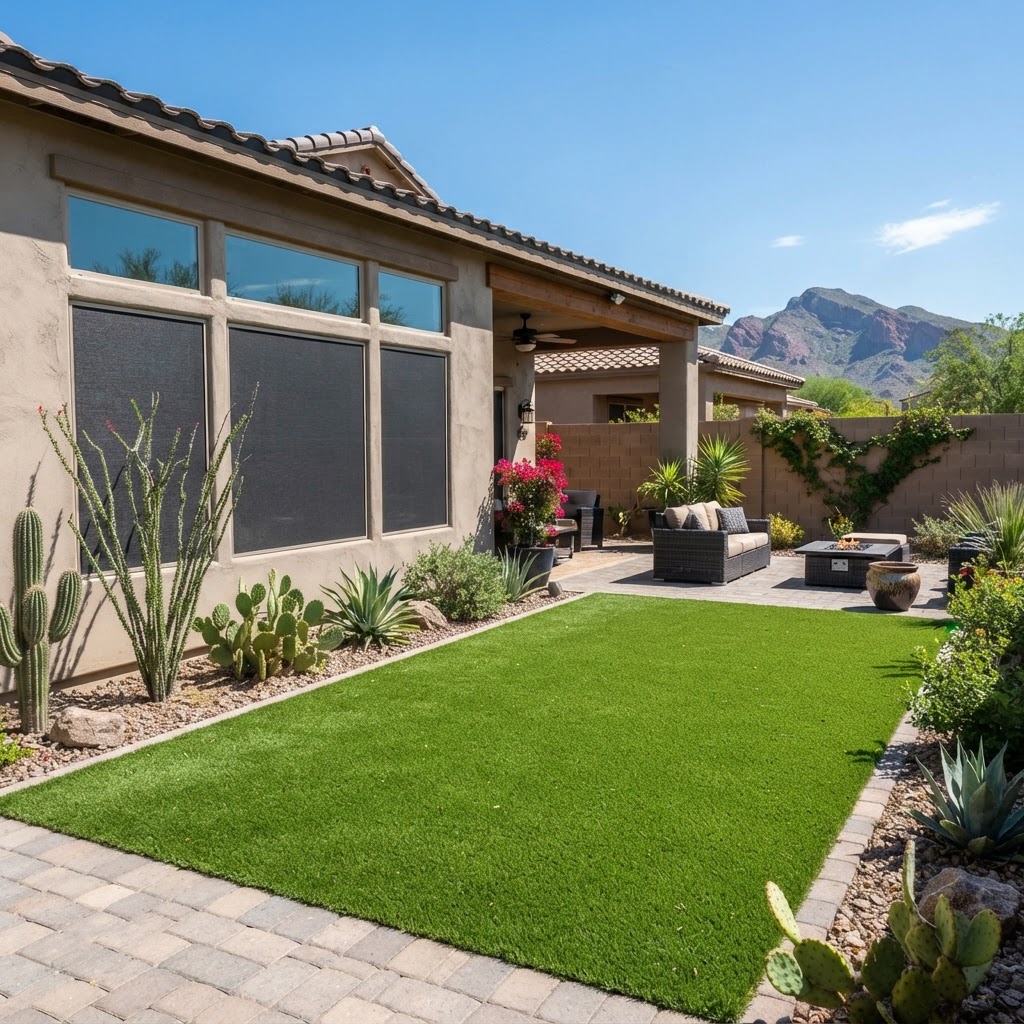
Yes, solar screens, also called sun screens, are one of the most effective ways to prevent turf burn. Mounted on the outside of the window, the mesh catches the sun before it reaches the glass, so the window can't bounce a concentrated beam of heat onto your artificial turf. If you just installed new turf, put sun screens on every window that faces it before the damage starts, not after you find the first melted streak.
Solar Screens and Sun Screens Are the Same Thing
"Solar screens," "sun screens," and "sunscreens for windows" all describe the same product: a dense exterior mesh, usually rated to block 80% or 90% of the sun's energy, mounted in a frame over the outside of the glass. Homeowners in the Phoenix Valley mostly buy them to cut heat and glare indoors. Protecting turf is a big second benefit that most people don't hear about until they've already lost a patch of lawn.
How Window Glare Burns New Turf
Modern energy-efficient (Low-E) windows have a thin metallic coating that reflects heat back outside. That's great for your power bill, but when sunlight hits that glass at the right angle, it bounces off as a focused hot spot. Dual-pane windows can also flex slightly inward in the heat, which can concentrate the reflection like a shallow mirror. Turf installers and window film companies report reflected hot spots reaching around 200°F, which is hot enough to soften and melt the plastic fibers in synthetic grass.
New turf is the most at risk because nobody is watching for it yet. The yard looks perfect for a few weeks, then a shiny, warped strip shows up in the same place near a slider or a big window. By then the blades are already fused.
Signs your windows are burning your turf
- The damage is always in the same spot, lined up with a specific window or sliding door
- Blades look melted or shiny, not just faded
- It's worst on clear, sunny afternoons
- The window faces south or west, or it's a second-story window above the yard
Why Sun Screens Stop the Burn
A solar screen fixes the problem at the source: the glass.
- The mesh absorbs and blocks most of the sunlight before it hits the window. An 80% or 90% solar mesh stops the majority of the sun's energy on the outside of the frame.
- Whatever light still reflects off the glass has to pass back through the mesh. That breaks up the beam and scatters it instead of letting it concentrate on one spot.
- No focused beam means no hot spot on the turf, the pavers, or nearby vinyl and plastic.
Even ordinary insect screens break up some of the reflection, which is why the problem often shows up on windows that have no screen at all. Solar mesh is much denser, so it does the job far more reliably.
Bonus: the same screen keeps that room cooler and cuts glare inside. It's one purchase solving two problems.
New Turf? Do This Before the First Hot Afternoon
- Map every window that faces the turf. Pay extra attention to south- and west-facing sliders and any second-story windows that look down on the yard.
- Check for hot spots on a sunny afternoon. Look for a bright, concentrated patch of glare on the turf. Check again in fall and spring, because the reflection path moves as the sun angle changes through the year.
- Put sun screens on the windows that hit the turf. 90% mesh is the strongest choice for west- and south-facing glass; 80% works for milder exposures. See our 80% vs. 90% solar screen guide.
- Match frame color and check your HOA. Many Valley HOAs have rules for exterior screens. Our HOA solar screen guide covers what's usually required.
- Leave the screens up year-round on turf-facing windows. Low winter sun can still throw a reflection across the yard.
Turf Burn Fixes Compared
- Solar screens (sun screens) — Stops the reflection?: Yes · Notes: Blocks the sun before it hits the glass; also cools the room
- Anti-reflective window film — Stops the reflection?: Partially to yes · Notes: Applied to the glass; doesn't cool the room as much as exterior mesh
- Replacing the burned turf — Stops the reflection?: No · Notes: The new patch burns in the same spot next season
- Heat-resistant turf — Stops the reflection?: Partially · Notes: Raises the melting point but the hot spot is still there
- Shade sails or patio covers — Stops the reflection?: Only where shaded · Notes: Turf outside the shade line still burns
What It Costs
Custom solar screens start at $30.77 through our factory-direct Screens2Go store, with final price based on window size. For most homes, screening the one or two windows causing the problem costs far less than replacing a burned section of turf, and it keeps the damage from coming back. Prefer we handle it? We'll find the offending windows, measure, and install.
For a deeper look at Low-E reflection and turf damage, read our turf burn prevention guide.
Serving Homeowners Across the Phoenix Valley
Window Screen Guys builds custom solar screens locally and serves Phoenix, North Phoenix, Scottsdale, North Scottsdale, Peoria, Surprise, Glendale, Cave Creek, Anthem, Mesa, Chandler, Gilbert, Tempe, Goodyear, and Buckeye. Licensed Arizona contractor, ROC #362719.
Protect Your New Turf Now
- DIY and save: order custom sun screens with instant pricing at Screens2Go.
- Done for you: call (480) 771-6091 or request a free quote.
Frequently Asked Questions
Do solar screens prevent turf burn?
Yes. Solar screens mounted on the outside of a window block most of the sunlight before it reaches the glass and scatter whatever light still reflects, so the window cannot focus a concentrated beam onto artificial turf.
Are solar screens and sun screens the same thing?
Yes. Solar screens, sun screens, and window sunscreens all refer to the same product: a dense exterior mesh, usually rated to block 80% or 90% of the sun's energy, mounted in a frame over the outside of the glass.
Why do windows melt artificial turf?
Energy-efficient Low-E windows reflect heat outward, and at certain sun angles the glass focuses that reflection into a hot spot that can reach around 200°F. That is hot enough to soften and melt the plastic fibers in synthetic turf.
Which solar screen mesh is best for stopping turf burn?
90% sun-blockage mesh is the strongest option for south- and west-facing windows with direct afternoon sun. 80% mesh can work on windows with milder exposure.
Do I need solar screens on every window?
No. You only need them on the windows whose reflection reaches your turf, usually south- or west-facing sliders and second-story windows above the yard. Many homeowners add solar screens to other sunny windows anyway for the cooling benefit.
Should I install sun screens before or after new turf goes in?
Before or right after. Turf burn usually appears within the first sunny stretch, and melted fibers cannot be repaired, only replaced. Screening turf-facing windows early protects the investment from day one.
Will my turf warranty cover melting from window reflection?
Often not. Many synthetic turf warranties exclude damage from reflected heat, so check your warranty and treat prevention as your responsibility.
Need help with your windows?
Shop Screens2Go