
Retractable vs. Sliding Screen Doors for Phoenix Homes
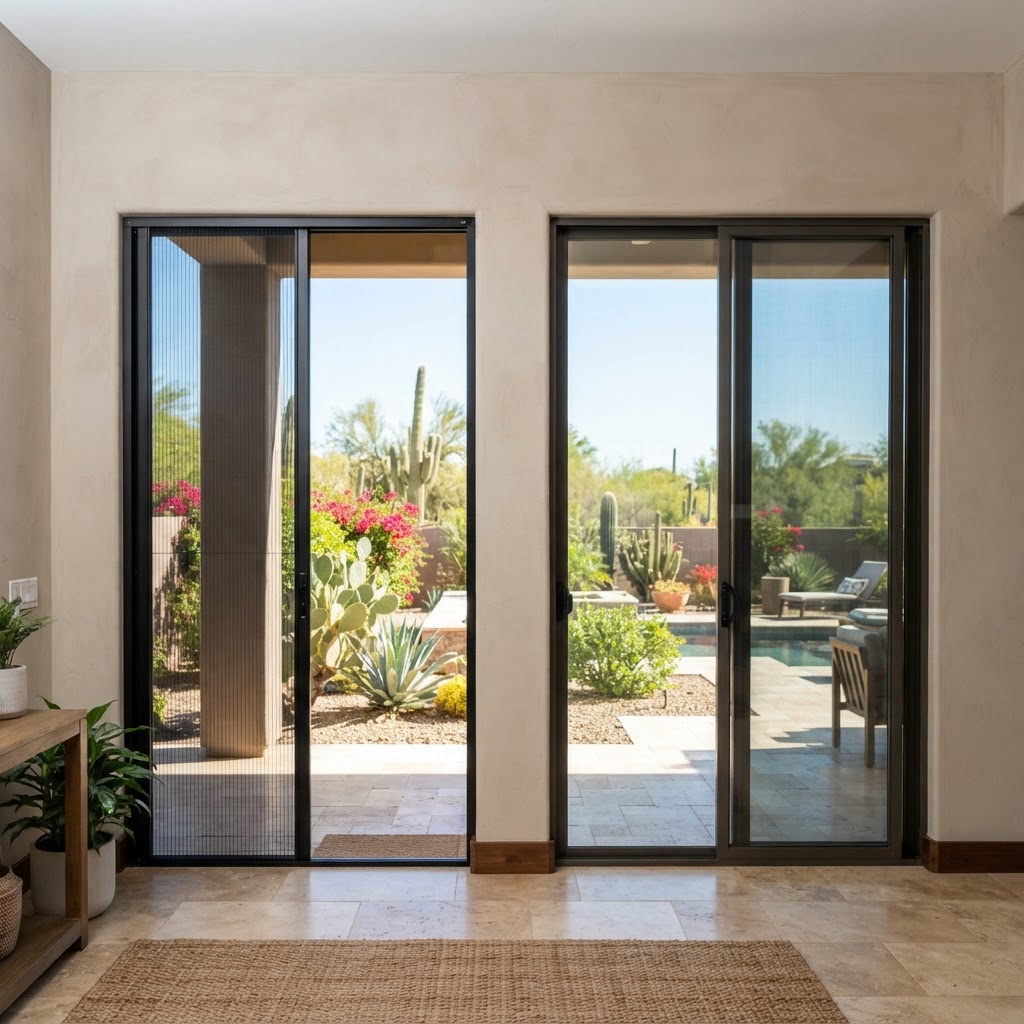
Choose a sliding screen door for high-traffic entries where durability and cost matter most, and a retractable screen door for entries where you want the screen invisible when it's not in use. In the Phoenix Valley, a third factor decides more cases than either of those: dust and monsoon wind, which are harder on retractable mechanisms than on a simple sliding panel.
Here's the honest comparison.
How Each One Works
Sliding screen doors run on a track parallel to a patio slider. The screen panel is always present, parked to one side when not in use. Simple mechanism: a frame, mesh, rollers, and a track.
Retractable screen doors store the mesh rolled inside a housing cassette mounted at the door jamb. You pull the mesh across when you want it and it retracts out of sight when you don't. More moving parts: a spring-loaded roller, a guide track at the sill, and a latching edge bar.
Side-by-Side Comparison
- Durability under heavy use — Sliding: Higher, fewer parts to fail · Retractable: Lower, mechanism wears with cycles
- Appearance when not in use — Sliding: Panel always visible · Retractable: Disappears into housing
- Works on hinged/French doors — Sliding: No · Retractable: Yes
- Tolerance for dust and grit — Sliding: High · Retractable: Lower, grit in the sill track causes binding
- Monsoon wind resistance — Sliding: Good when properly seated · Retractable: Mesh can billow or pull free
- Kid and pet friendly — Sliding: Yes, with pet mesh · Retractable: Less so, mesh and mechanism take abuse
- Repair cost — Sliding: Low, rollers and mesh are cheap · Retractable: Higher, mechanism or cassette replacement
- Upfront cost — Sliding: Lower · Retractable: Higher
- View when open — Sliding: Panel parked in the frame · Retractable: Unobstructed
Where Sliding Wins in Arizona
Dust tolerance. A sliding screen's track is simple and easy to sweep or vacuum. A retractable's bottom guide track is narrow, and fine Valley dust accumulates in it. When it does, the mesh drags or catches, and the retraction stops being smooth.
Monsoon wind. A properly seated sliding panel takes wind loading across a rigid frame. Retractable mesh has no rigid frame in the middle, so it can billow, and on some models a hard gust pulls the mesh out of the guide track entirely.
Cost of ownership. When a sliding screen fails, you're usually replacing rollers or re-screening the panel, both inexpensive. When a retractable mechanism fails, you're often replacing the cassette assembly.
Heavy family traffic. A sliding panel with steel rollers tolerates hundreds of cycles a week. Retractables are rated for use, but the busiest door in a house with kids and dogs is not the place to find their limit.
Where Retractable Wins
Hinged, French, and entry doors. This is the big one. If your opening isn't a slider, a sliding screen isn't an option at all. Retractables are the clean solution for front doors and French doors.
Curb appeal. On a front entry, especially on Scottsdale and Cave Creek homes where the entry is an architectural feature, a retractable screen disappears when you're not using it. A parked sliding panel doesn't.
Unobstructed views. With a retractable, the opening is genuinely clear when the screen is stowed. A sliding panel always occupies part of the opening.
Wide openings that only get seasonal use. If you open a large patio door mainly during the pleasant months, a retractable gives you the screen when you want it and gets out of the way the rest of the year.
How to Decide: Three Questions
- Is the opening a slider or a hinged/French door? Hinged or French narrows you to retractable immediately.
- How many times a day does this door get used? More than roughly twenty cycles a day with kids or pets in the mix points strongly to sliding.
- Does the appearance of the opening matter more than anything else? If yes, and traffic is moderate, retractable.
Many Valley homes end up with both: a heavy-duty sliding screen on the family-room patio door and a retractable on the front entry.
Arizona Installation Details Worth Insisting On
- Powder-coated aluminum, not painted, since painted finishes chalk under Valley UV
- UV-stable mesh on west- and south-facing openings, which take the worst exposure
- Metal rollers on sliding doors; plastic wheels seize in heat and under load
- Sealed or brush-guarded bottom track on retractables to keep dust out of the guide
- Proper sill preparation, since an out-of-level sill is the most common cause of retractable binding
Get the Right Door for Each Opening
Window Screen Guys installs both sliding and retractable screen doors across Phoenix, Scottsdale, Peoria, Surprise, Glendale, Cave Creek, Anthem, and North Phoenix. We'll tell you which one fits each opening in your home, and where it's worth paying for the retractable versus where a heavy sliding door is genuinely the better product. Licensed Arizona contractor, ROC #362719.
Call (480) 771-6091 or request a free quote.
Frequently Asked Questions
Are retractable screen doors worth it in Arizona?
On hinged doors, French doors, and front entries they're often the only good option and well worth it. On a high-traffic patio slider used by kids and pets, a heavy-duty sliding screen usually delivers better value because it has fewer parts to fail and much cheaper repairs. Dust and monsoon wind are harder on retractable mechanisms than on sliding panels.
Which lasts longer, a retractable or a sliding screen door?
A well-built sliding screen door with metal rollers generally lasts longer under heavy use, because the mechanism is simpler. Retractables have a spring-loaded roller, a guide track, and a latching bar, meaning more components that can wear, bind, or collect dust. Under light to moderate use, a quality retractable can last many years.
Can you put a retractable screen on a sliding patio door?
Yes, retractables can be installed on some slider configurations, but a conventional sliding screen is usually the more practical and less expensive choice for a slider. Retractables make the most sense where a sliding screen physically cannot work: hinged doors, French doors, and swinging entry doors.
Why does my retractable screen door stick or drag?
Most commonly, dust and grit in the bottom guide track, or a sill that isn't level. In the Phoenix Valley, track debris is the leading cause. Vacuum the guide track regularly and avoid lubricants that attract dust. If it persists after cleaning, the housing may be out of plumb and need re-shimming.
Do retractable screens hold up in monsoon wind?
Less well than a rigid sliding panel. Retractable mesh has no frame across its middle, so it can billow under a hard gust, and some designs will pull free of the guide track. The practical habit is to retract the screen when a storm is coming, which is easy since retracting it is the normal resting state anyway.
Need help with your windows?
Shop Screens2Go