
How to Measure Odd-Shaped Windows for Custom Screens
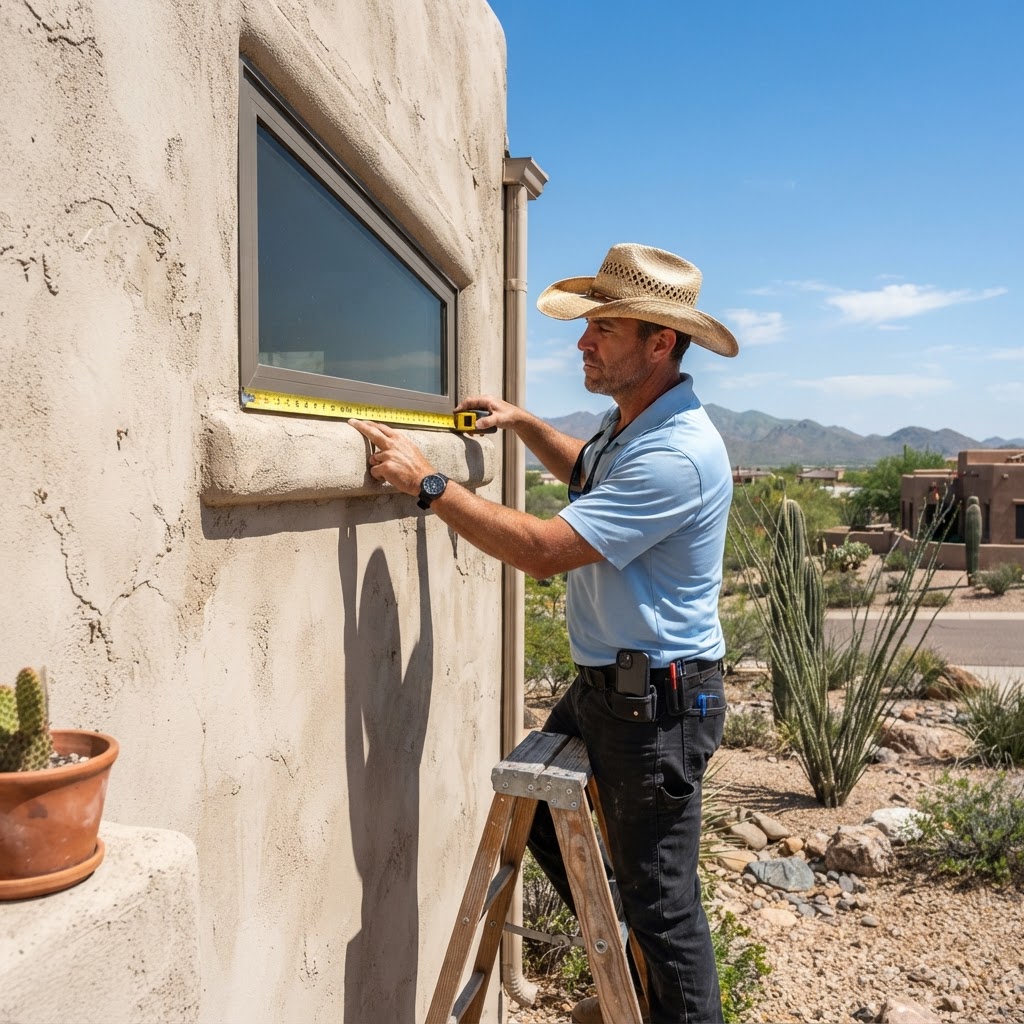
Odd-shaped windows — arches, trapezoids, hexagons, angled transoms, and bay or bow configurations — can't be measured with the same single width-by-height method used on a standard rectangular window, because a single pair of numbers can't describe a curve or an angle. Getting these openings right means measuring multiple points along every edge and, for true curves, taking a rubbing or template of the shape itself.
This is the guide to use before you order screens for anything that isn't a plain rectangle — Phoenix's Spanish, Santa Fe, and Mediterranean-style homes are full of them.
What Counts as an Odd-Shaped Window
- Arched or eyebrow windows — a curved top over a straight or curved bottom
- Trapezoid and triangle windows — common above garage doors and on vaulted gable ends
- Hexagon and octagon windows — decorative accent windows, often fixed
- Angled transoms — set at a slope above a door or window line
- Bay and bow windows — multiple angled panels meeting at a point
- Extreme oversized openings — technically rectangular, but too large for stock screen frame stock to span without extra bracing
If you're specifically dealing with an arched window, see our dedicated guide to measuring arched and oversized screens for curve-specific steps. This guide covers the rest of the shapes.
Tools You'll Need
- Steel tape measure (cloth tapes stretch and introduce error)
- A large sheet of butcher paper, kraft paper, or cardboard for templates
- A pencil and straightedge
- Painter's tape to hold a template in place while you trace
The General Measuring Principle
Measure every straight edge at both ends, and for any curve, take a full-size template rather than a handful of measurements. A handful of points on a curve can be connected a dozen different ways; a traced template can't be misread.
Step-by-Step by Shape
Trapezoids and triangles: Measure the full width of the bottom edge, the full width of the top edge (if any), and the vertical height from the center of the bottom edge to the peak or top edge. Then measure both diagonal (slanted) sides separately — they are often not equal, even when a window looks symmetrical.
Hexagons and octagons: Measure each individual edge separately, in order, going around the opening. Note the exact sequence so whoever builds the frame can reproduce it correctly.
Angled transoms: Measure the horizontal width at the base, the vertical height at both the left and right ends, and the slope distance along the top edge.
Bay and bow windows: Each panel gets measured and ordered as its own separate screen — treat a three-panel bay as three individual rectangular or trapezoidal screens, not one continuous piece.
True curves (eyebrow arches, ellipses, circles): Tape butcher paper directly over the opening from the outside, trace the exact inside edge of the frame with a pencil, cut it out, and hold it back up to the window to confirm the fit before sending it off. This template becomes the pattern the screen is built from.
Common Measuring Mistakes
- Measuring only one point on a "straight" edge. Settling and construction tolerances mean two ends of the same edge are rarely identical.
- Assuming symmetry. A trapezoid window that looks even from across the room often has two different diagonal lengths.
- Using a cloth tape measure. It stretches under tension and throws off every measurement taken with it.
- Skipping the template on true curves. A curve described in a few linear measurements is a guess, not a measurement.
When to Let Us Measure Instead
Multi-panel bays, true ellipses, and anything mounted higher than a standard ladder can safely reach are where a DIY measurement is most likely to go wrong — and where a wrong screen is the most expensive to redo. If the shape has more than four sides or any curve at all, it's usually faster and cheaper in the long run to have us measure it once, correctly, on-site.
Get It Measured Right the First Time
Window Screen Guys builds true custom screens — curved, angled, and oversized — for homes across the Phoenix Valley, licensed Arizona contractor ROC #362719. We'll measure or template any opening on-site and factory-build the screen to match it exactly.
Call (480) 771-6091 or request a free on-site quote.
Have standard rectangular windows too? Configure and price those yourself online at Screens2Go.
Frequently Asked Questions
Can I measure an arched window the same way as a trapezoid window?
No. A trapezoid is made of straight edges and can be fully described with a handful of length measurements. An arch is a curve and needs a traced, full-size template to be reproduced accurately — a few measurement points aren't enough to define the curve correctly.
What if my odd-shaped window isn't listed here?
Most unusual shapes break down into a combination of straight edges and curves. Apply the straight-edge method to any flat sections and the template method to any curved sections, or have us measure it on-site if you're unsure.
Do custom odd-shaped screens cost more than rectangular ones?
Yes, typically. They take more time to template or measure and more care to fabricate a matching frame, especially for true curves. Pricing is quoted per opening once we have accurate dimensions.
Can I template a window from the inside instead of the outside?
It's possible, but outside templating usually matches the actual screen-mounting surface more closely, since most screens mount to the exterior trim or frame. If you template from inside, double-check the fit against the outside opening before ordering.
How long does it take to get a custom odd-shaped screen built?
Similar to other custom screens — typically 5 to 10 business days after an accurate measurement or template is in hand, since these are factory-built to the opening rather than pulled from stock.
Need help with your windows?
Shop Screens2Go