
Golf Ball Protection Screens: How Phoenix Valley Homeowners Stop Broken Windows on the Course
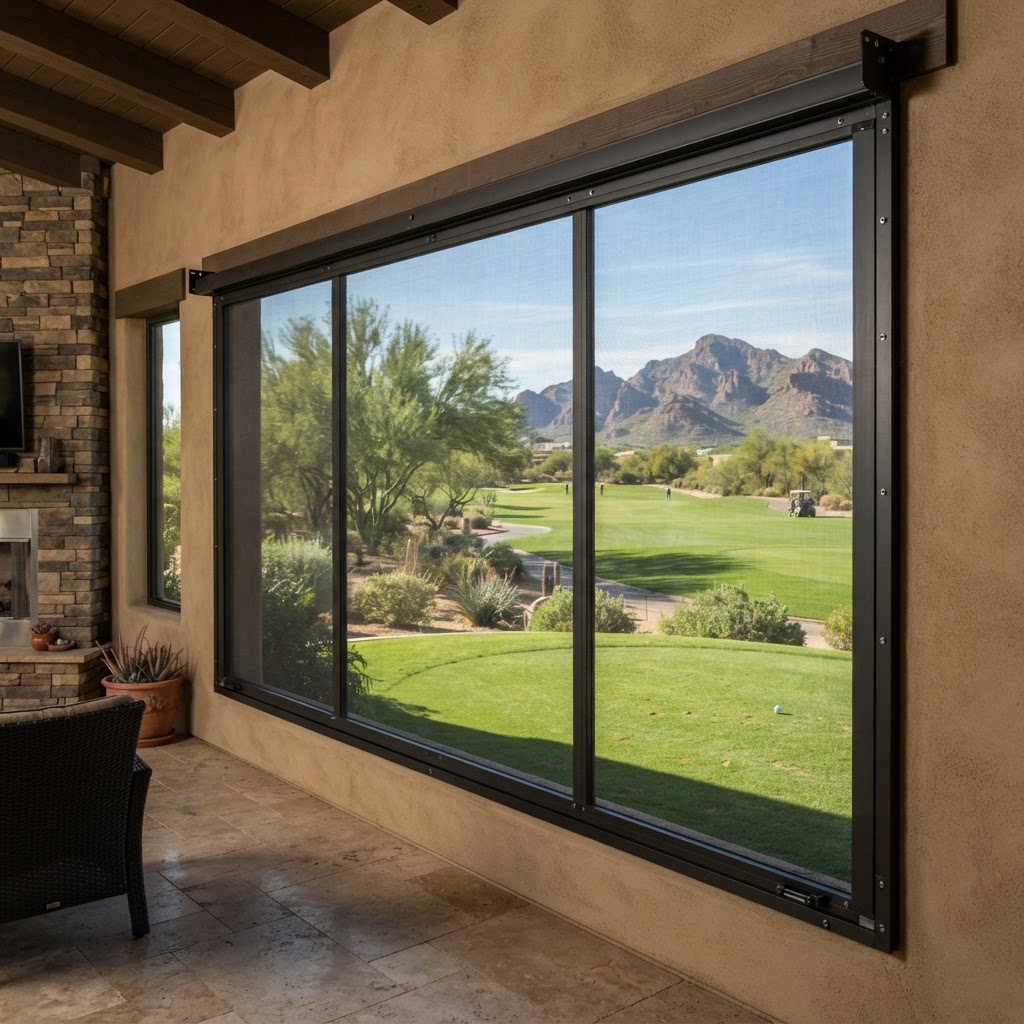
Golf ball protection screens are heavy-gauge mesh panels mounted several inches off the glass, so a struck ball hits a flexible, energy-absorbing surface instead of your window. The standoff gap is the part that does the work: the screen deflects and decelerates the ball across the whole panel rather than transferring the impact into a single point on the glass.
If your back patio faces a fairway anywhere in the Phoenix Valley, this is the difference between an annoying thud and a $900 glass replacement.
Why Standard Window Screens Don't Help
A normal insect screen is bonded directly to a light aluminum frame that sits flush in the window channel. Two problems:
- No standoff. The mesh is within a half inch of the glass, so a ball pushes the screen straight into the window. The glass takes nearly the full impact anyway.
- No strength. Standard fiberglass insect mesh is engineered to stop a mosquito, not a 1.62-ounce projectile traveling at highway speed. It tears on the first hit.
Even pet-resistant mesh, which is dramatically tougher than standard fiberglass, isn't designed for point impact at speed. Pet mesh resists claws and chewing — a very different load.
How Protection Screens Are Actually Built
Three things separate a real golf ball screen from a heavy-duty insect screen:
1. The standoff mount. The frame is bracketed away from the glass, creating a gap that lets the mesh flex and dissipate energy before anything reaches the window. This is the single most important design element.
2. Heavy-gauge mesh. A dense, high-tensile weave that stretches under impact rather than tearing. It absorbs and redirects rather than resisting rigidly.
3. A reinforced frame. Thicker-walled aluminum with corner reinforcement, because the frame has to transfer impact loads into the wall structure, not just hold mesh taut.
Miss any one of the three and you have a screen that fails on the first serious hit.
Where Valley Homeowners Need Them Most
The risk isn't evenly distributed across a fairway lot. Highest-exposure openings are usually:
- Windows and sliders facing a landing zone — roughly 220 to 280 yards out from a tee box is where most amateur slices come to rest
- The right side of a hole for right-handed players — the slice is the most common miss in amateur golf, which is why right-side homes take disproportionate damage
- Large patio sliders and picture windows — biggest target, most expensive to replace, and often tempered glass that shatters completely rather than cracking
- Second-story windows — frequently overlooked, and often hit by high approach shots that clear the ground-floor screens entirely
We see this pattern repeatedly in Anthem, Sun City, Sun City West, Gold Canyon, Scottsdale's course communities, and the golf corridors in Peoria and Surprise.
Comparison: Your Realistic Options
- Golf ball protection screens — Stops golf balls: Yes · Keeps the view: Mostly — slight tint · Airflow: Yes · Notes: Removable, no glass modification
- Impact-rated / laminated glass — Stops golf balls: Yes · Keeps the view: Yes · Airflow: No · Notes: Expensive, whole-window replacement
- Security screens — Stops golf balls: Partially · Keeps the view: Mostly · Airflow: Yes · Notes: Built for intrusion, not point impact
- Standard or pet mesh — Stops golf balls: No · Keeps the view: Yes · Airflow: Yes · Notes: Tears on first hit
- Exterior roll-down shades — Stops golf balls: Partially · Keeps the view: No when down · Airflow: Limited · Notes: Only protects while deployed
- Netting or barrier fencing — Stops golf balls: Yes · Keeps the view: No · Airflow: Yes · Notes: Often restricted by HOA and course rules
For most fairway homes, protective screens win on cost per opening and on the fact that you keep your view and your airflow. Impact glass is the gold standard for pure protection, but replacing a wall of sliders is a different budget conversation entirely.
Questions to Ask Before You Buy
When you're comparing quotes, the answers that actually matter:
- How far off the glass does the frame mount? If the answer is "flush," it's not a protection screen.
- What frame gauge and corner construction? Stamped corners on thin extrusion will fail at the joint.
- Is the mesh UV-stabilized? Arizona sun degrades unstabilized polymer fast. A screen that's brittle in three summers is a screen that shatters instead of flexing.
- Can it be removed seasonally? Many snowbird households want them off during the months the house sits empty, or want the option to take them down for window cleaning.
- Does it fit non-standard openings? Course-facing walls are usually the architectural showpiece of the house, which means oversized and irregular openings.
What They Cost
Pricing depends on opening size, frame gauge, mount type, and how many openings you're protecting — a single second-story window is a very different number from a 16-foot patio slider wall. Because these are built to the opening rather than pulled from stock, there's no meaningful list price. We measure on-site and quote per opening so you can protect the three highest-risk windows first and phase the rest.
Protect the Windows That Keep Getting Hit
Window Screen Guys builds and installs golf ball protection screens for fairway homes across Phoenix, Scottsdale, Anthem, Sun City, Sun City West, Peoria, Surprise, Gold Canyon, and the surrounding Valley. We'll walk the course-facing side of your home, identify which openings are actually in the line of fire, and quote them individually. Licensed Arizona contractor, ROC #362719.
Call (480) 771-6091 or request a free on-site quote.
Need standard bug, solar, or pet screens at the same time? Configure and price those yourself online at Screens2Go.
Frequently Asked Questions
Do golf ball protection screens really stop a golf ball?
Yes, when they're built correctly. The key is the standoff gap between the screen and the glass. That gap lets the heavy-gauge mesh flex and absorb the ball's energy across the whole panel instead of driving it into a single point on the window. A screen mounted flush to the glass does not provide this protection, no matter how tough the mesh is.
Can I use a security screen instead of a golf ball screen?
Security screens are engineered to resist cutting, prying, and forced entry, which is a sustained load rather than a high-speed point impact. Some offer partial protection, but they're generally rigid and mounted close to the glass, so they don't dissipate impact energy the way a standoff protection screen does. They solve a different problem.
Will golf ball screens block my view of the course?
The mesh is denser than an insect screen, so there's a slight tint and some loss of clarity, similar to looking through a solar screen. You retain your outward view and your airflow. Most fairway homeowners find it a reasonable trade against replacing tempered glass sliders repeatedly.
Does homeowners insurance cover golf ball window damage?
Coverage varies by policy and carrier, and a deductible often exceeds the cost of a single window, so many homeowners end up paying out of pocket. Repeat claims can also affect your premium. Check your specific policy — this is a question for your insurance agent, not a general rule.
Can golf ball protection screens be removed?
Yes. They're built as removable panels, so they can be taken down for window cleaning, seasonally while a snowbird home sits empty, or if you sell the house. Ask for release hardware at time of install if seasonal removal matters to you.
Which windows should I protect first if I can't do the whole house?
Start with the openings in the landing zone for the hole behind you, especially on the right side if you're on a hole where right-handed slices tend to land. Large patio sliders and picture windows are the most expensive to replace, so they usually justify protection first. Second-story windows are commonly overlooked and often hit by high approach shots.
Need help with your windows?
Shop Screens2Go