
How Damaged Window Screens Reduce Home Airflow
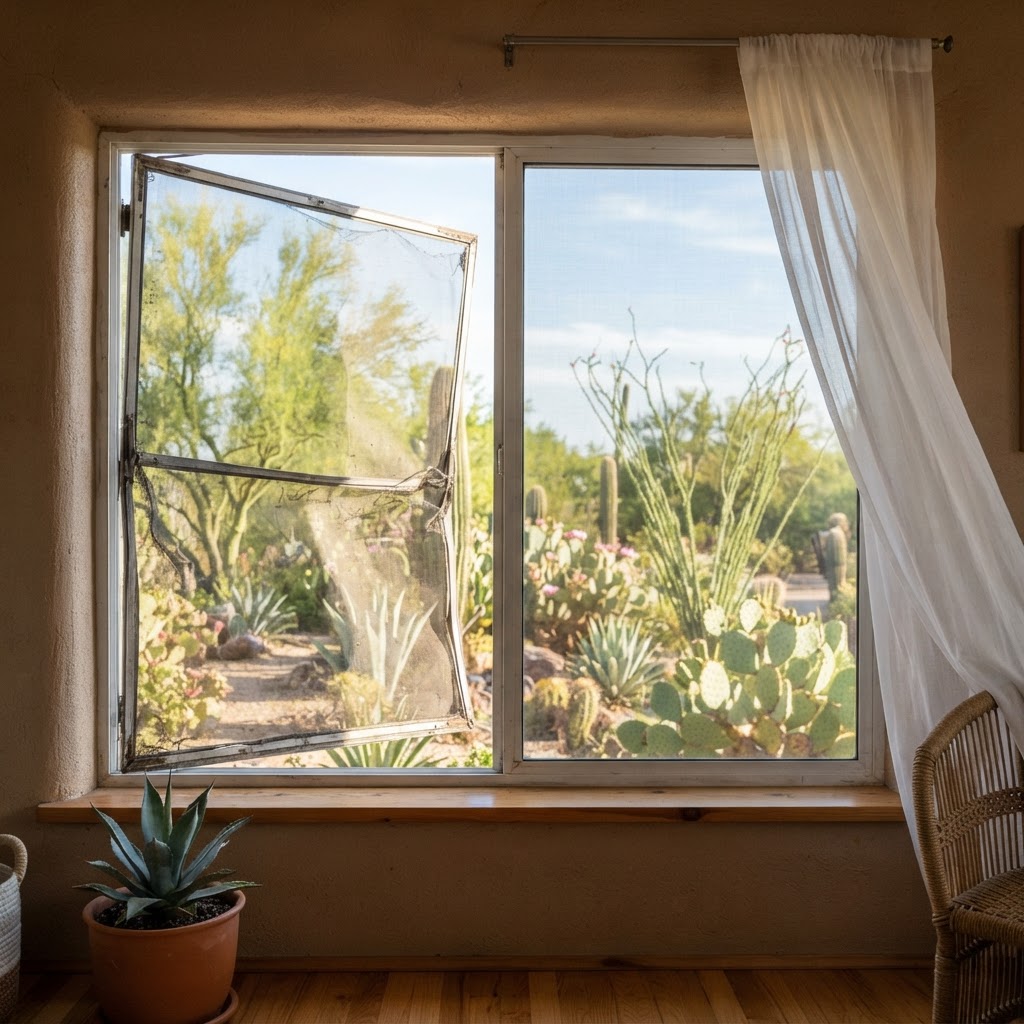
Damaged window screens reduce home airflow by physically blocking the open area of the window. Dust-caked mesh, sagging fabric that bows into the frame, and warped frames that no longer sit flush all cut the amount of air that can move through an open window — which is why a room with "open windows" can still feel stagnant. In the Phoenix Valley, where fine dust loads onto screens every monsoon season, this happens faster than most homeowners expect.
The Three Ways Screens Restrict Ventilation
Screen mesh always costs you some airflow — even a brand-new screen blocks a portion of the window opening, because the mesh itself occupies space. That's normal and unavoidable. The problem is when damage multiplies that restriction.
1. Dust and Pollen Clogging
This is the biggest offender in Arizona. Every haboob and monsoon storm drives a fine layer of desert dust into the mesh weave. Add pollen, pool chemicals, and cooking grease near kitchen windows, and the open squares in the mesh gradually fill in. A screen that looks "a little dirty" from across the room can be substantially occluded when you hold it up to the light.
The telltale sign: hold a flashlight on one side of the screen at night and look from the other side. Clean mesh glows evenly. Clogged mesh looks blotchy and dark.
2. Sagging and Bowing Mesh
After years of 110°F-plus heat cycling, fiberglass mesh stretches. A stretched screen bows outward or inward instead of sitting flat in the frame. When it bows inward against the window track, it creates a dead pocket where air stalls instead of flowing through cleanly. Sagging mesh also tends to catch and hold more dust than taut mesh, so the two problems compound.
3. Warped Frames and Bad Fit
A frame that's bent, corner-split, or simply the wrong size for the opening won't seat properly. Homeowners compensate by leaving the window open a smaller amount so the screen doesn't fall out, or by wedging the screen in at an angle. Either way, you lose usable opening. Frames that rattle in wind are usually frames that aren't seated — and an unseated screen is both an airflow problem and a bug problem.
Why This Matters More in the Phoenix Valley
Most Valley homeowners only open windows during a narrow window of good weather: the cool evenings in spring and fall, and the early mornings after a monsoon cools things off. Those are precisely the hours when you're trying to flush hot air out of the house and pull cooler air in without running the AC.
If your screens are restricting that exchange, you lose the benefit of the only free cooling the desert gives you. Homeowners in Surprise, Peoria, Glendale, Scottsdale, and North Phoenix often tell us they "stopped bothering" with opening windows — and when we inspect, the screens are half-clogged with three seasons of dust.
Poor ventilation also means indoor air stays stale longer, which matters in a tightly sealed modern home where cooking odors, humidity from showers, and off-gassing from furnishings have nowhere to go.
Signs Your Screens Are Choking Airflow
- You open a window and feel almost no draft, even on a breezy evening
- The mesh looks gray or tan rather than its original charcoal or black
- You can see a visible outline where the mesh sags away from the frame
- The screen rattles or shifts when wind hits it
- Fine dust collects on the windowsill inside, even with the window closed
- Rooms on the same side of the house feel noticeably stuffier than others
Clean, Repair, or Replace?
- Dusty mesh, frame and weave intact — Best Fix: Professional cleaning · Why: Restores most of the lost airflow at the lowest cost
- Small tear, mesh otherwise taut — Best Fix: Re-screen that panel · Why: Cheaper than a new frame; mesh is the consumable part
- Sagging or brittle mesh — Best Fix: Re-screen · Why: Stretched mesh can't be re-tensioned reliably
- Bent, split, or corner-failed frame — Best Fix: Full replacement · Why: A compromised frame will never seat flush again
- Wrong-size screen from a prior owner — Best Fix: Custom replacement · Why: Standard sizes rarely fit Valley homes correctly
The short version: mesh is a wear part, frames are not. If the frame is square and solid, re-screening is almost always the better value. If the frame is damaged, replacing the whole screen makes more sense than patching it.
How to Keep Airflow Up Between Replacements
- Rinse screens twice a year — once before monsoon season and once after. A garden hose and a soft brush handle most of it.
- Never pressure-wash a screen. High pressure stretches mesh and pops it loose from the spline, turning a cleaning job into a re-screening job.
- Check the spline. The rubber cord that holds mesh in the frame groove dries out and shrinks in desert heat. Loose spline means loose mesh.
- Re-seat screens after storms. Wind lifts screens out of their tracks more often than people realize.
- Bundle screen cleaning with window washing so the glass and the mesh get handled in one visit.
Get Your Screens Breathing Again
Window Screen Guys custom-builds and installs window screens across Phoenix, Scottsdale, Peoria, Surprise, Glendale, Cave Creek, Anthem, and North Phoenix. We'll walk your home, tell you honestly which screens just need a cleaning and which ones are past saving, and re-screen or replace only what actually needs it. We're a licensed Arizona contractor, ROC #362719.
Prefer to handle installation yourself? Order custom-built screens through our sister service, Screens2Go — we fabricate to your measurements and drop them off on our Valley-wide pickup and delivery routes.
Call (480) 771-6091 or request a free quote and get real airflow back through your windows.
Frequently Asked Questions
Do window screens reduce airflow even when they're new?
Yes. Any screen mesh blocks part of the window opening, so some airflow reduction is normal and expected. The issue is damage and dust buildup, which can cut airflow well beyond that baseline. A clean, taut, properly fitted screen gives you close to the best airflow a screened window can deliver.
How often should window screens be cleaned in Phoenix?
Twice a year is a good baseline for the Phoenix Valley — once in late spring before monsoon season and once in early fall after the storms pass. Homes near open desert, active construction, or unpaved roads often need it more often because of heavier dust loading.
Can a dirty screen make a room feel hotter?
Indirectly, yes. A clogged screen limits how much cooler outside air you can pull in during the evening and early morning, so the house holds heat longer. The screen itself doesn't generate heat, but it does limit your ability to flush warm air out naturally.
Is it cheaper to repair or replace a damaged window screen?
If the frame is straight and solid, re-screening (replacing just the mesh) is almost always cheaper than a full replacement. If the frame is bent, split at a corner, or the wrong size for the opening, a new custom screen is the better investment because a compromised frame will never seat flush.
Will a solar screen reduce airflow more than a regular screen?
Solar screens use a denser weave than standard insect mesh, so they do restrict airflow somewhat more. Most Valley homeowners find the tradeoff worth it on west- and south-facing windows, where blocking heat gain matters more than maximizing breeze. A common approach is solar screens on sun-exposed windows and standard mesh on the shaded side of the house.
Need help with your windows?
Shop Screens2Go