
How to Check Torn Window Screens for Bug Leaks
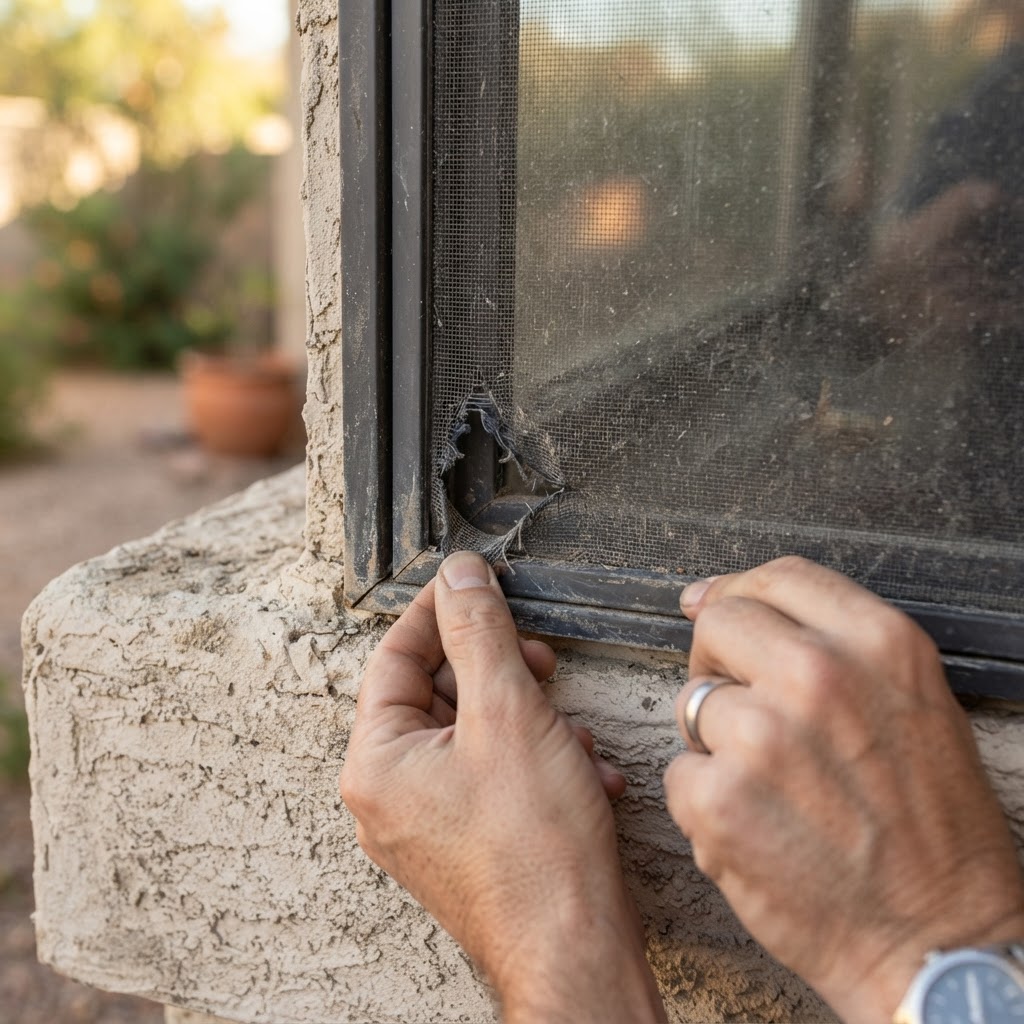
To check a window screen for bug leaks, inspect four things in order: the mesh surface, the spline groove around the perimeter, the frame corners, and the fit between the screen and the window track. Most homeowners only look at the first one. In practice, the majority of insect entry points in Phoenix Valley homes are gaps at the edges — not tears in the middle of the mesh.
A scorpion needs about a credit-card thickness of gap. A cricket needs less than a quarter inch. Neither of them needs the big obvious hole you already noticed.
The 4-Point Screen Inspection
Do this from the inside during daylight, then again at night with a flashlight from the outside. The two passes catch different things.
1. The Mesh Surface
Run the flat of your hand lightly across the mesh. You're feeling for:
- Punctures — small holes from hail, debris, or a pet's claw
- Slits — straight cuts, usually from a tool or a tree branch
- Thinning — areas where UV has made fiberglass brittle and chalky; press gently and it crumbles
- Stretched pockets — the mesh sags away from the plane of the frame
Brittle mesh is the sneaky one. It hasn't torn yet, but it will, and it can't be patched — the material around any patch is just as degraded.
2. The Spline Groove
The spline is the flexible rubber cord pressed into the frame channel that holds the mesh taut. Desert heat dries spline out, shrinks it, and lets it back out of the groove. Walk your finger along all four sides. If you feel the spline sitting proud of the groove, or you can see a gap between the mesh and the frame, that entire edge is an open door for insects — often several feet of it.
This is the single most common bug leak we find, and it's almost invisible from more than three feet away.
3. The Frame Corners
Screen frames are four pieces of aluminum joined by corner keys. Heat cycling and rough handling work those joints loose. Squeeze each corner. If it flexes, shifts, or shows daylight through the joint, insects are using it. Split corners also mean the frame is no longer square, which causes the next problem.
4. The Fit in the Track
With the screen installed, look at the perimeter where it meets the window frame. Any place you can see daylight is a gap an insect can use. Common culprits:
- Screens cut undersized by a previous owner or a big-box "standard size" purchase
- Missing or broken tension springs and clips, so the screen sits loose
- Warped frames that bow away from the track on one side
- Missing corner pull tabs that homeowners removed, leaving a notch
The Flashlight Test
The fastest way to find every leak at once: after dark, have someone stand outside with a bright flashlight while you stand inside in a dark room with the light shining at the screen. Every gap, tear, and loose edge shows up as a bright point or line. Mark them with a piece of painter's tape and you'll have a complete repair list in ten minutes per room.
Run this test in late spring, before monsoon season and before the Valley's scorpion and cricket activity picks up.
Repair or Replace? The Honest Answer
- Single small puncture, mesh otherwise taut and flexible — Repair: Patch or re-screen
- Spline backed out, mesh intact — Repair: Re-spline (inexpensive)
- Multiple tears across one screen — Replace: Re-screen the panel
- Brittle, chalky, crumbling mesh — Replace: Re-screen the panel
- Loose or split frame corner — Replace: New frame
- Screen doesn't fit the opening — Replace: Custom-built replacement
- Pet damage that keeps recurring — Replace: Upgrade to pet-resistant mesh
A useful rule: mesh is a consumable, frames are an asset. If the frame is square, solid, and correctly sized, re-screening is the economical fix and will last years. If the frame is compromised or the wrong size, patching the mesh just delays the real repair.
Why Phoenix Homes Leak More Than Most
Three local factors accelerate screen failure here:
- UV intensity. Valley sun degrades fiberglass mesh and dries out spline faster than almost any other US climate.
- Monsoon debris. Haboob-driven gravel and palo verde branches puncture mesh and knock screens out of track every summer.
- Extreme heat cycling. Daily swings from 80°F to 115°F expand and contract aluminum frames, working corner joints loose over time.
That's why screens that would last a decade in a mild climate often need attention every few years in Surprise, Peoria, Glendale, Scottsdale, North Phoenix, and Cave Creek.
Get Every Leak Sealed
Window Screen Guys inspects, re-screens, and custom-builds window screens throughout the Phoenix Valley. We'll run the full four-point check on every opening in your home, tell you which screens need nothing, and fix only the ones that actually have a problem. Licensed Arizona contractor, ROC #362719.
If you'd rather install them yourself, order custom-built screens through Screens2Go — we fabricate to your measurements and drop them at your door on our Valley-wide routes.
Call (480) 771-6091 or request a free quote.
Frequently Asked Questions
How do bugs get in when my window screens look fine?
Usually through the perimeter, not the mesh. The most common paths are a spline that has backed out of the frame groove, a loose or split frame corner, or a screen that doesn't fit its opening tightly. All three are easy to miss visually and are best found with a nighttime flashlight test.
Can you patch a torn window screen, or does it need full replacement?
A single small puncture in otherwise healthy mesh can be patched, and it will hold. But if the mesh is brittle, chalky, or has multiple tears, patching fails quickly because the surrounding material is just as degraded. In that case, re-screening the panel is the right fix — and it's usually less expensive than people expect.
What size gap can a scorpion get through?
Bark scorpions can squeeze through gaps roughly the thickness of a credit card. That means a spline gap or a loose screen edge you can barely see is more than enough. Sealing screen perimeters is one of the more effective non-chemical steps Valley homeowners can take.
How often should I inspect my window screens in Arizona?
Twice a year: once in late spring before monsoon season and insect activity peaks, and once in early fall after the storms pass. Inspect immediately after any significant dust storm, since wind commonly lifts screens out of their tracks and drives debris into the mesh.
Does pet-resistant mesh keep bugs out better than regular screen?
Pet-resistant mesh doesn't have a finer weave than standard insect screen, so it's not better at blocking small insects on its own. What it does is resist the tearing that creates bug entry points in the first place. For households with dogs or cats, the practical result is fewer holes and fewer leaks over time.
Need help with your windows?
Shop Screens2Go