
Everything to Know About Battery-Powered Window Shades
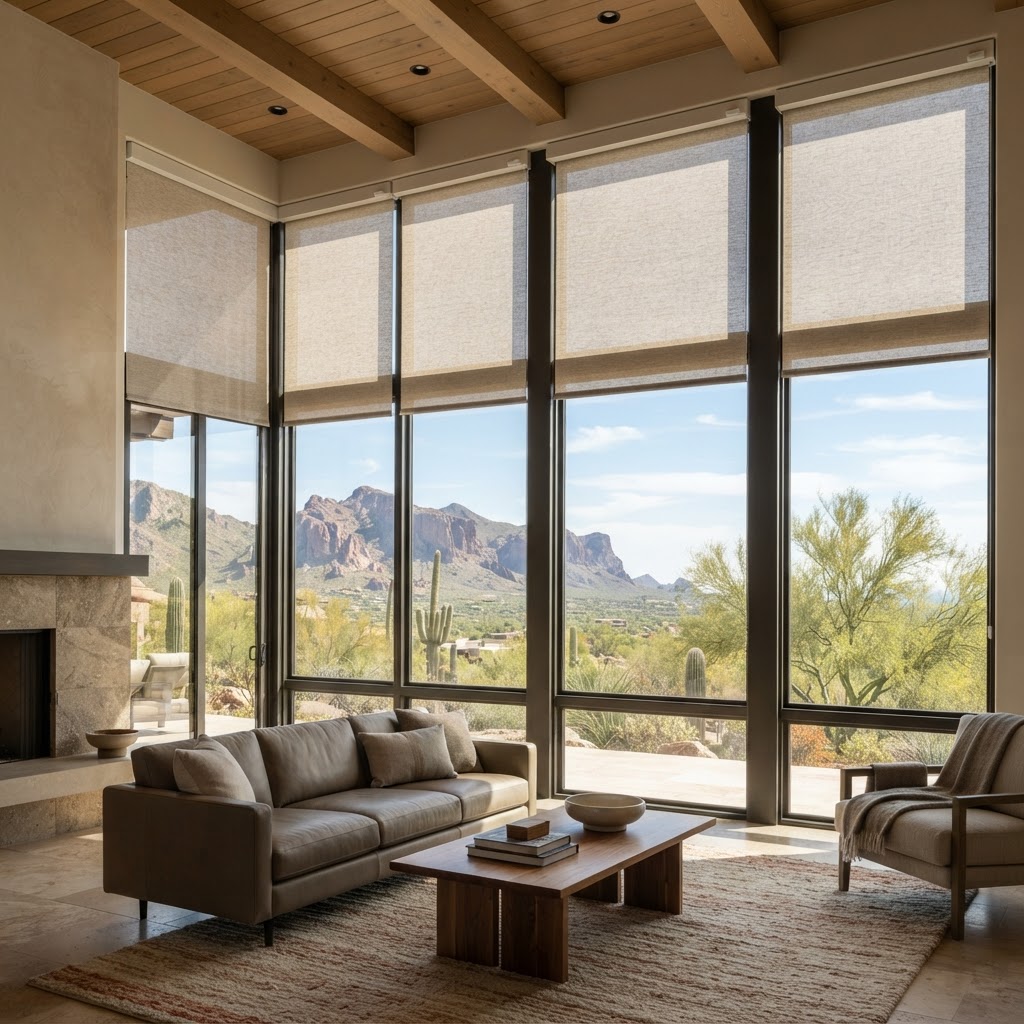
Battery-powered window shades are motorized shades driven by a rechargeable battery tube inside the roller, operated by remote, wall switch, or app — no wiring and no cords. For Arizona homes they solve two problems that come up constantly: tall or hard-to-reach windows that nobody wants to operate manually, and the cord-free requirement that makes a room genuinely safe for kids and pets.
Here's what actually matters when you're considering them.
How They Work
A rechargeable lithium battery tube slides inside the shade's roller and drives a small motor. You charge it with a USB cable every several months to a year, depending on use. Control options:
- Handheld remote — simplest, no setup, works reliably
- Wall-mounted switch — looks hardwired, mounts anywhere with adhesive or screws
- App and smart home — requires a bridge or hub; enables schedules and voice control
- Solar charging panel — a small panel on the window recharges the battery continuously
That last option deserves attention in Phoenix. We get roughly 300 sunny days a year, which makes solar-assisted charging genuinely practical here in a way it isn't in cloudier climates. On a sun-facing window, a solar panel can keep the battery topped off indefinitely.
Where Battery Shades Earn Their Cost
Tall and hard-to-reach windows. Two-story great room windows, transoms above sliders, clerestory windows, and stairwell windows. If operating a shade requires a ladder, it never gets operated — which means you get none of the heat control you paid for.
Child and pet safety. Corded shades are a recognized strangulation hazard for young children. Cordless is the standard recommendation for homes with kids, and battery-powered motorization gets you cordless without giving up the ability to raise and lower easily.
Wide banks of windows. A row of five windows on the same wall operated as a group, on one command, is the difference between using them daily and never touching them.
Automated heat management. This is the Arizona-specific payoff. Scheduling west-facing shades to close automatically at 2pm — before the afternoon sun loads the room — does more for comfort and cooling cost than closing them manually at 5pm when the room is already hot.
Where They Don't Make Sense
Be skeptical of motorizing every window in the house. On a standard, easily reachable bedroom window that you adjust twice a day, a good cordless manual shade does the same job at a fraction of the cost and never needs charging. Motorization pays off where reach, grouping, or scheduling is the actual problem.
Battery Life in Phoenix Heat
This is the question we get most, and the honest answer has nuance.
Manufacturers typically quote battery life in cycles — often somewhere around several hundred to over a thousand raise-and-lower cycles per charge. In practice, what shortens it here:
- Heavier shades draw more power. A large blackout shade uses meaningfully more per cycle than a small light-filtering one.
- Frequent cycling. A scheduled shade that runs twice daily uses far more than one adjusted occasionally.
- Heat. Lithium batteries degrade faster at sustained high temperatures. A battery tube in a shade on a west-facing window behind glass in a Phoenix summer is in a hot environment.
Practical guidance for Valley homes: expect to recharge more often than the brochure suggests on sun-facing windows, and strongly consider the solar charging panel on any window that gets direct sun — it turns the maintenance question into a non-issue.
Choosing the Fabric: The Part That Matters Most in Arizona
The motor is the convenience. The fabric is what determines whether the shade actually does anything about heat.
- Light-filtering — Light: Soft diffused light · Heat rejection: Low · Best for: North-facing rooms, ambiance
- Solar screen shade (3-5% openness) — Light: Preserves view, cuts glare · Heat rejection: Moderate to good · Best for: West and south windows where view matters
- Solar screen shade (1% openness) — Light: Dim, view mostly retained · Heat rejection: Better · Best for: Harsh afternoon exposure
- Room darkening — Light: Very low · Heat rejection: Good · Best for: Bedrooms, media rooms
- Blackout with side channels — Light: None · Heat rejection: Best · Best for: Bedrooms, west-facing, sleep quality
The openness factor on solar shade fabric is the number to ask about. Lower openness means more heat and glare rejection, but less view through. On a west-facing Valley window, a 3% openness fabric is a common sweet spot — it cuts the worst of the afternoon load while you can still see the yard.
Other Arizona-Specific Factors
- Fabric fade. Valley UV is punishing. Ask specifically about UV-stable fabric and confirm the warranty covers fading, not just mechanical failure.
- Exterior vs. interior. An interior shade stops heat after it has already passed through the glass. Blocking heat outside the glass — with solar screens or exterior roller shades — is more effective for pure heat rejection.
- Reverse roll on deep sills. On a deep window sill, a reverse roll keeps the fabric closer to the glass and reduces the gap that lets hot air convect into the room.
- Side channels. For bedrooms and true blackout, side channels eliminate the light gap along the edges. Without them, blackout fabric still leaks light at the sides.
Consider Layering Instead of Choosing
The most effective setup we see in Valley homes isn't shades or screens — it's both. Solar screens on the outside of the glass stop a large share of the heat before it enters, and an interior shade handles glare, privacy, and light level. The screen does the thermal work; the shade does the comfort work.
Talk It Through With Someone Local
Window Screen Guys works with homeowners across Phoenix, Scottsdale, Peoria, Surprise, Glendale, Cave Creek, Anthem, and North Phoenix on shades, blinds, solar screens, and the combinations that work best in our climate. We'll tell you honestly which windows are worth motorizing and which ones aren't. Licensed Arizona contractor, ROC #362719.
Call (480) 771-6091 or request a free quote.
Frequently Asked Questions
How long do battery-powered window shades last on one charge?
Manufacturers typically quote several hundred to over a thousand raise-and-lower cycles per charge, but real-world life depends on shade size, fabric weight, and how often it cycles. In Phoenix, sustained heat on sun-facing windows also shortens battery life somewhat. A solar charging panel on a sun-exposed window largely eliminates the recharging chore.
Are battery-powered shades safe for homes with young children?
Yes, and that's one of their main advantages. They have no operating cords, which removes the strangulation hazard associated with corded window coverings. Cordless operation is the standard recommendation for any room used by young children, and motorization gives you that without losing easy operation on tall windows.
Do battery-powered shades work on very large or tall windows?
They're often the best option for large and hard-to-reach windows, because a manual shade on a two-story great room window simply doesn't get used. For very large or heavy shades, confirm the motor is rated for the shade's weight and consider solar charging, since heavier shades draw more power per cycle.
Are motorized shades or solar screens better for blocking heat in Arizona?
Solar screens are more effective at pure heat rejection because they stop sunlight outside the glass, before it enters the room. Interior shades work after the heat has already passed through the window. Many Valley homes get the best result from both: solar screens on sun-exposed windows for thermal control, and interior shades for glare, privacy, and light level.
Can battery-powered shades connect to smart home systems?
Most can, though it usually requires a bridge or hub from the same manufacturer. Once connected, you can schedule shades to close before peak afternoon heat, which is where the real energy benefit comes from in Phoenix. Without automation, most homeowners close shades after the room is already hot.
Need help with your windows?
Shop Screens2Go